The Gut Microbiome and Diet: What Do We Actually Know?
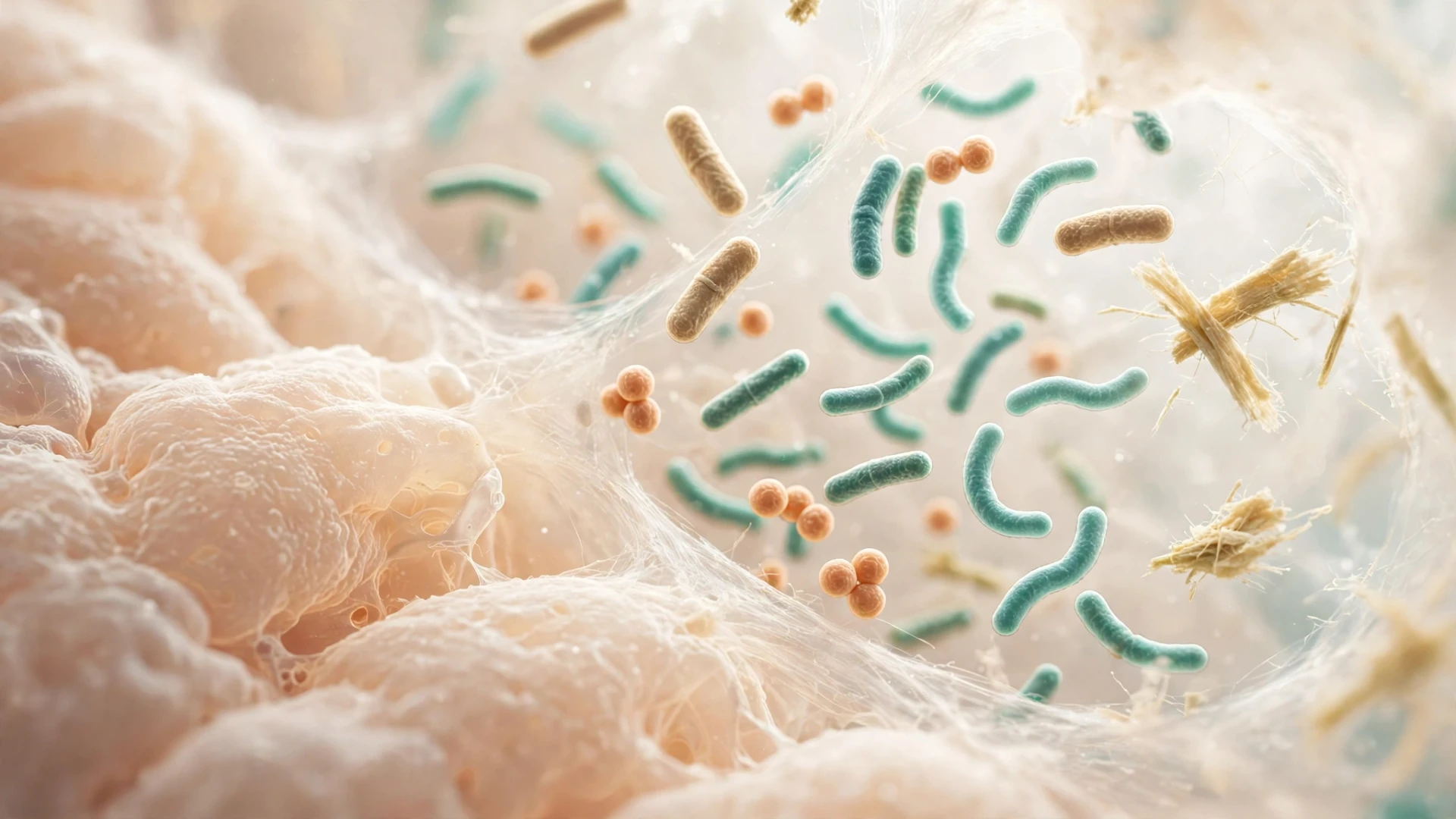
The gut microbiome has become one of the fastest-growing areas of nutrition science. We now know that the microorganisms in the gut are not merely passive inhabitants of the digestive system. They break down certain components of food, produce a range of substances, and take part in complex interactions with the human body.
This raises important scientific questions. Can what we eat change the microbiome? Are features of the microbial community associated with better health? And might we one day use this information to make dietary recommendations more precise?
Science has already answered some of these questions. For others, however, the evidence remains far more limited than popular claims about “good bacteria” and personalized microbiome tests would suggest.
What Do We Actually Mean by the Microbiome?
The human digestive tract is home to a vast diversity of microorganisms—predominantly bacteria, but also archaea, fungi, and other microorganisms. We call this community the gut microbiota.
The term microbiome is broader. It encompasses the microorganisms, their genetic material, their functions, and their interactions with the environment.
The distinction matters because modern science is interested not only in which microorganisms are present in the gut. Increasingly, the question is what they do and how they interact with one another, with food, and with the human body.
This is where diet becomes a particularly important part of the story.
How Does Food Interact with Gut Microorganisms?
Much of the nutrient content of food is broken down and absorbed in the small intestine. Some food components, however, cannot be fully broken down by human digestive enzymes.
Some dietary fiber, for example, reaches the colon. There, certain microorganisms can use and break it down through a process called fermentation.
This process produces a range of substances. Among the best studied are the short-chain fatty acids (SCFAs)—acetate, propionate, and butyrate.
These are more than simple end products of bacterial activity. Butyrate, for example, is an important energy source for the cells lining the colon. Microbial metabolites can also interact with the immune, metabolic, and nervous systems.
This is one reason the relationship between diet and the microbiome attracts so much scientific interest. Certain food components can alter conditions in the gut and the activity of microorganisms; the substances those microorganisms produce can, in turn, interact with human physiology.
Diet Influences the Microbiome—but Not in the Same Way for Everyone
Diet is one of the important factors associated with the composition and function of the gut microbiota.
Dietary fiber receives particular attention. But an important qualification is needed: “fiber” is not a single substance.
Different types of dietary fiber have different chemical structures and properties. Some are readily fermented by gut microorganisms; others are fermented much less. Different sources of fiber can therefore interact with the microbiota in different ways.
The overall dietary pattern matters as well.
In 2026, a large study published in Nature Medicine analyzed data from 10,068 people and identified numerous associations between dietary habits and features of the gut microbiome.
The researchers found associations both with overall dietary patterns and with specific foods. Coffee consumption, for example, was associated with the relative abundance of Lawsonibacter asaccharolyticus, yogurt with Streptococcus thermophilus, and milk with some Bifidobacterium species.
These findings are interesting, but they need to be interpreted correctly.
Association does not necessarily mean causation.
If a particular dietary feature occurs alongside a particular feature of the microbiome, this does not automatically prove that one directly caused the other. Still less does it show that the observed microbial difference necessarily improves or harms health.
This distinction matters in almost every discussion of the microbiome.
Is There Such a Thing as a “Healthy Microbiome”?
Intuitively, we would like the answer to be simple.
If we could identify which bacteria are “good” and which are “bad,” we could measure the microbiome and determine whether it is healthy.
In practice, it is far more complex.
The microbiomes of healthy people can differ substantially. Their composition is influenced by many factors, including diet, age, medications, lifestyle, geography, and characteristics of the individual.
Context matters too. A microorganism does not exist in isolation, but as part of a complex community. The presence or abundance of a single species is therefore rarely enough to characterize the state of the system as a whole.
It is increasingly important to understand not only which microorganisms are present, but also what functions the microbial community performs.
This is one reason science still has no single, universal model of an “ideal microbiome” that applies to everyone.
A Change in the Microbiome Does Not Automatically Mean Better Health
This is another important distinction.
A change in diet may be followed by measurable changes in the composition or activity of the gut microbiota.
But the fact that something has changed does not automatically tell us whether the change is beneficial, harmful, or of little practical significance.
To claim that a particular change in the microbiome leads to a specific health benefit, we need evidence that links the change to a real health outcome and allows us to assess causality.
This is especially important for products and diets marketed chiefly on the claim that they “improve the microbiome.”
A change in the microbiome is not, in itself, a health outcome.
Can the Microbiome Explain Why We Respond Differently to Food?
It probably accounts for some of the variation—and this is one of the most intriguing directions in current research.
People differ in the composition and functions of their gut microbiota. At the same time, microbial communities can process components of food and produce substances that interact with human physiology.
This raises a legitimate scientific question: could the microbiome contribute to differences in how people respond to the same food or dietary pattern?
Recent scientific reviews point to evidence that the gut microbiome contributes to differences in dietary response, including some postprandial responses. But the magnitude and significance of that contribution depend on context and remain under investigation.
The microbiome is therefore part of the picture.
That does not mean it is the whole picture.
Can a Microbiome Test Identify Our Ideal Diet?
This is often where science and marketing begin to part company.
The idea is appealing: analyze the gut microbiome, identify which microorganisms are present, and receive a personalized list of foods we should or should not eat.
The science has not yet reached that level of certainty.
The 2026 study of more than 10,000 participants shows how much information can be extracted by combining dietary data with microbiome analysis. The researchers were able to model associations among dietary intake, microbial diversity, individual microorganisms, and microbial functions.
This represents a significant scientific advance.
But a model that detects or predicts associations is not the same as a clinically validated system that reliably identifies the optimal diet for a particular person.
Further steps are needed: the findings must be reproducible and generalize across different populations; above all, it must be shown that recommendations based on them actually lead to better health outcomes.
Microbiome analysis can therefore be a valuable research tool today.
But a consumer microbiome test still cannot reliably answer the question:
“What is the best diet for me?”
What Do We Know Today?
We know that diet and the gut microbiome are linked.
We know that certain food components can be used by microorganisms and converted into substances that interact with human physiology.
We know that microbiomes can differ substantially from one person to another, and that these differences probably contribute to some individual responses to diet.
But we still do not know enough to turn every microbiome profile into a reliable, individualized dietary prescription.
This does not diminish the importance of microbiome science. Quite the opposite.
What is truly interesting is not the promise that we can already read an ideal diet from a single sample. It is the prospect of gradually understanding yet another of the complex mechanisms through which food interacts with the human body.
And, as so often in science, the more precise answer is more interesting than the simpler one.
References
- Sanz Y, Cryan JF, Deschasaux-Tanguy M, et al. The gut microbiome connects nutrition and human health. Nature Reviews Gastroenterology & Hepatology. 2025;22:534–555.
- Segev T, Barak D, Zahavi L, et al. Diet–microbiome associations in 10,068 individuals from the Human Phenotype Project to guide personalized nutrition. Nature Medicine. 2026;32:1884–1894.
- Ross FC, Patangia D, Grimaud G, et al. The interplay between diet and the gut microbiome: implications for health and disease. Nature Reviews Microbiology. 2024;22:671–686.
- Brinck JE, Sinha AK, Laursen MF, et al. Intestinal pH: a major driver of human gut microbiota composition and metabolism. Nature Reviews Gastroenterology & Hepatology. 2025;22:639–656.